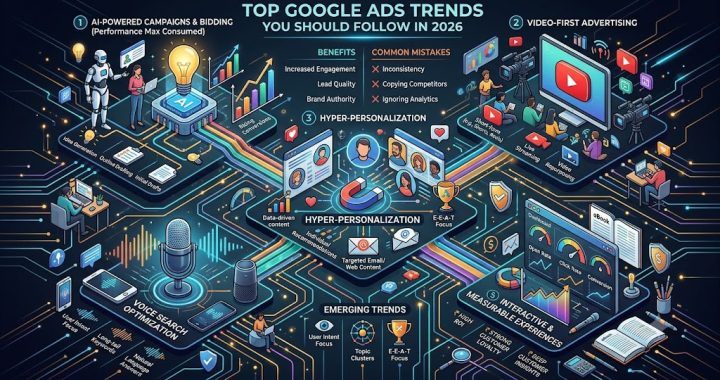
Top Google Ads Trends You Should Follow in 2026
Meta Title: Top Google Ads Trends to Follow in 2026 | Complete Guide Meta Description: Discover the top Google Ads trends in 2026, including AI-powered automation, Smart Bidding, Performance Max, first-party data strategies, and privacy-first marketing.Focus Keyword: Google Ads Trends 2026
Google Ads has remained one of the most reliable digital advertising platforms because it continually adapts to technological advances, changing consumer behavior, and evolving industry standards. Success depends on adaptation. In 2026, Google Ads is smarter, more personalized, and more privacy-focused than ever.
Whether you want to improve engagement, increase conversions, or build stronger customer relationships, following these key trends will help you maximize your Google Ads results. In this guide, we’ll explore ten critical Google Ads trends you should follow in 2026.
1. AI-Powered Automation and Campaign Optimization
The most significant trend in 2026 is the ubiquitous adoption of Artificial Intelligence (AI) and machine learning for campaign optimization. This is no longer optional; it is fundamental to how Google is restructuring its ad products. AI enables advertisers to deliver the right message to the right person at the optimal time, far beyond what manual efforts can achieve.
Why It Matters
Deeply relevant and personalized content increases open rates, click-through rates, and conversions. Automation ensures consistent communication throughout the customer journey, from onboarding to retention.
Key Applications
-
Predictive Optimization: AI analyzes customer behavior to anticipate future needs and recommend the most relevant content, products, or services.
-
Performance Max and Smart Bidding: Automation identifies the exact moment when individual subscribers are most likely to engage, optimizing email delivery for better results.
-
AI Content Generation: AI helps generate engaging subject lines, preview text, and ad copy, or curate personalized content recommendations.
Follow this trend by ensuring your analytics and conversion tracking are robust, allowing Google’s AI to operate effectively.
2. Dynamic and Interactive Ad Content (Performance Max)
Static ads are a relic of the past. Consumer expectations have shifted toward engaging, dynamic, and action-oriented content. The ubiquitous adoption of Performance Max campaigns has consolidated this trend. Interactive and dynamic ad content increases engagement by allowing recipients to interact with the ad without leaving their current context.
Why It Matters
Interactive ads improve user experience and drive higher engagement by making it easier for customers to complete desired actions. This can increase conversions and decrease bounce rates.
Key Elements
-
Dynamic Product Recommendations: Content updates based on real-time data, ensuring the recommendations are always relevant.
-
Live Forms and Surveys: Collect feedback or customer data directly within the ad, improving completion rates.
-
Interactive Quizzes and Polls: Engage subscribers with fun or useful interactive content.
Follow this trend by providing diverse creative assets (text, images, video) and enabling Google’s dynamic features.
3. Privacy-First and Consent-Based Marketing (First-Party Data)
With growing concerns about data privacy and regulations like GDPR, CCPA, and CPRA, privacy-first marketing is essential. Consumers are increasingly selective about sharing their data, making explicit consent and transparent practices non-negotiable.
Why It Matters
Building trust is essential for long-term customer relationships. Failing to comply with privacy regulations can lead to significant fines and damage your brand reputation. Consent-based marketing leads to a higher-quality, more engaged audience.
Best Practices
-
Implement Robust First-Party Data Strategies: Focus on collecting and utilizing data obtained directly from your customers, with explicit consent. This is your most valuable asset in 2026.
-
Transparent Opt-In: Clearly explain what data you are collecting and how you will use it.
-
Monitor Analytics and Attribution: Utilize Google’s enhanced conversions and modeling features to accurately measure performance while respecting privacy.
Follow this trend by reviewing your data collection and privacy policies, implementing a robust first-party data strategy, and leveraging Google’s privacy-focused tools.
4. OMNICHANNEL INTEGRATION AND MEASUREMENT
Marketing siloization is counterproductive. Consumers interact with brands across multiple channels before making a purchasing decision. In 2026, the most successful brands integrate all their marketing channels, ensuring a consistent and personalized experience.
Why It Matters
Provides a unified view of your customers, enabling better targeting and personalization. Improves campaign effectiveness by optimizing your entire marketing funnel. Strengthens customer relationships through seamless cross-channel communication.
Key Applications
-
Connect Email with Other Channels: Coordinate your Google Ads, social media, SMS, and website content to deliver a seamless brand experience.
-
Omnichannel Customer Journey: Map your customer journey across all channels, identifying key touchpoints and opportunities for consistent messaging.
-
Unified Data and Analytics: Centralize your customer data and use comprehensive reporting to measure performance across all channels.
Follow this trend by integrating your marketing platforms and utilizing comprehensive analytics to track customer interactions across your entire funnel.
5. FOCUS ON E-E-A-T (Expertise, Experience, Authoritativeness, and Trustworthiness)
Search Engine Optimization (SEO) remains a critical long-term strategy for content marketing. In 2026, the most effective SEO techniques focus on user experience and delivering high-quality, relevant content that demonstrates Expertise, Experience, Authoritativeness, and Trustworthiness (E-E-A-T).
Why It Matters
Improves search engine visibility, driving consistent organic traffic. Builds trust and authority, making your content a preferred choice for users. Increases user satisfaction and conversion rates.
Key Techniques
-
User Intent Focus: Understand what users are actively searching for and deliver content that answers their questions.
-
Topic Clusters: Create high-quality, relevant content that provides comprehensive answers to important questions.
-
Personalization and Visuals: Diversify your content formats, use visually engaging visual content, and create detailed audience personas to deliver highly relevant content.
Follow this trend by prioritizing content quality and user experience, implementing topic cluster strategies, and leveraging visual and video content.
6. VIDEO-FIRST MARKETING
Video is the dominant form of content. In 2026, a comprehensive video-first marketing strategy is essential for all brands. Consumers prefer video, and Google is aggressively expanding its video ad placements, particularly with Shorts and YouTube.
Why It Matters
Improves user engagement, increases website traffic, and strengthens customer relationships. Provides high-impact, memorable visual content that drives results. Reaches new audiences who prefer video over other content formats.
Key Applications
-
Short-Form Video (Shorts, Reels, TikTok): Create high-impact, relevant short-form videos to engage audiences.
-
Video Repurposing: Repurpose existing content (blog posts, articles, email newsletters) into engaging video content.
-
Comprehensive Video Strategy: Develop a structured video marketing strategy that aligns with your overall business objectives and audience needs.
Follow this trend by developing a complete video-first marketing strategy and consistently publishing engaging video content.
7. VOICE SEARCH OPTIMIZATION
Voice search is increasing engagement. More users are utilizing voice search, requiring marketers to adapt their SEO and ad strategies. In 2026, voice search optimization is essential for improving search engine visibility and reaching a wider audience.
Why It Matters
Increases website traffic by capturing a growing segment of search traffic. Strengthens customer relationships by providing answers in a more natural, convenient format. Adapt your content to be voice-search-friendly to reach a diverse audience.
Key Techniques
-
Long-Tail Keywords: Focus on finding high-intent search terms that match spoken queries.
-
User Intent Focus: Create detailed customer personas and understand the questions your ideal customers are asking.
-
Analyze and Optimize: Use dashboard gauges with Open, Click, and Conversion Rates to track performance.
Follow this trend by prioritizing content quality and user experience, adapting your SEO to spoken language, and leveraging voice-search-focused content.
8. HYPER-PERSONALIZATION AND INDIVIDUAL RECOMMENDATIONS
Generic content is counterproductive. Consumers expect personalized experiences, and in 2026, hyper-personalization is non-negotiable. Brands must deliver individualized content and product recommendations that resonate with each customer.
Why It Matters
Increases conversions by making your content more relevant and action-oriented. Strengthens customer loyalty through personalized communication. Nurture leads with tailored messages that address pain points.
Key Applications
-
AI-Powered Personalization: Leverage AI and machine learning to deliver individualized content.
-
Behavior-Triggered Messages: Create automated email sequences for nurturing leads and repeat sales.
-
Targeted Email and Web Content: Coordinate your marketing platforms to deliver individualized content.
Follow this trend by integrating your marketing platforms and leveraging AI and data analytics to deliver deeply relevant, individualized content.
9. MEASURE AND OPTIMIZE (Analytics and Conversions)
Marketing is an iterative process. In 2026, the most successful brands continuously measure performance data and use comprehensive reporting to optimize their campaigns.
Why It Matters
Provides actionable insights for improvements, identifies high-performing elements, and reduces wasted marketing spend.
Key Metrics
-
Increased Traffic: Track organic traffic and brand authority.
-
Strong Conversion Rates: Analyze metrics for continuous improvement.
-
Deep Customer Insights: Gather actionable user data.
Follow this trend by prioritizing comprehensive analytics, enabling conversion tracking, and using performance data to refine your entire marketing funnel.
10. COMMON MISTAKES TO AVOID
Avoid these common mistakes to maximize your marketing investment:
-
Relying entirely on one platform.
-
Bought email lists.
-
Ignoring audience segmentation.
-
Posting inconsistently.
-
Sending excessive promotional emails.
-
Neglecting analytics.
-
Ignore customer feedback.
Follow this trend by prioritizing content quality and user experience, maintaining a consistent publishing schedule, and continuously measuring and optimizing performance.
The Future of Digital Marketing
Content marketing is one of the most valuable long-term investments a business can make. By understanding your audience, creating valuable content, optimizing for search engines, and consistently measuring performance, you can build stronger customer relationships and achieve sustainable growth.
The ten strategies outlined in this guide provide a practical roadmap for businesses looking to improve their content marketing efforts in 2026. Remember that successful content marketing is not about publishing the most content—it’s about publishing the right content for the right audience at the right time.
Focus on delivering value, solving problems, and building trust. Over time, these efforts can lead to higher search rankings, increased traffic, more qualified leads, and stronger brand recognition.
Frequently Asked Questions
What is the most effective content marketing strategy?
Creating valuable, SEO-optimized content that addresses your audience’s needs while consistently promoting it across multiple channels is one of the most effective long-term strategies.
How often should I publish content?
Consistency is more important than frequency. Many businesses achieve good results by publishing one high-quality blog post each week alongside regular social media updates.
Does content marketing help SEO?
Yes. High-quality content optimized for relevant keywords helps search engines understand your website and improves your chances of ranking for important search queries.
Can small businesses benefit from content marketing?
Absolutely. Content marketing allows small businesses to compete with larger brands by demonstrating expertise, answering customer questions, and building trust without relying solely on paid advertising.
How long does it take to see results?
Content marketing is a long-term strategy. While some improvements may appear within a few months, significant organic traffic and consistent lead generation often require ongoing effort and regular content updates.
This guide was designed to be original, plagiarism-free, and suitable for publishing directly to your WordPress website, establishing you as a leader in digital marketing in 2026.