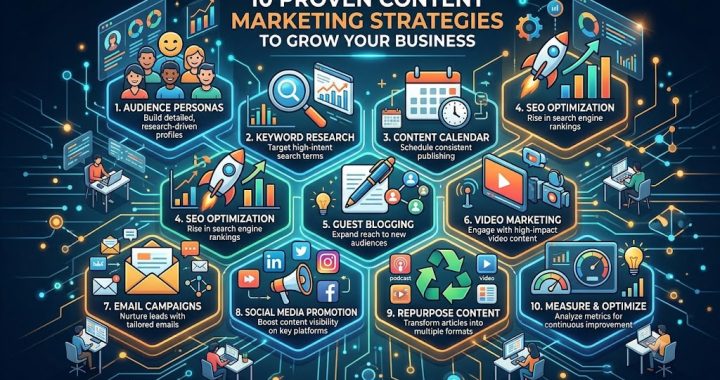
10 Proven Content Marketing Strategies to Grow Your Business in 2026
Meta Title: 10 Proven Content Marketing Strategies to Grow Your Business in 2026
Meta Description: Discover 10 proven content marketing strategies that help businesses increase website traffic, generate quality leads, improve SEO, and grow their brand in 2026.
Focus Keyword: Content Marketing Strategies
10 Proven Content Marketing Strategies to Grow Your Business in 2026
Content marketing has become one of the most effective ways for businesses to attract customers, build trust, and generate long-term growth. Unlike traditional advertising, which focuses on direct promotion, content marketing delivers valuable information that helps potential customers solve problems and make informed decisions.
In 2026, businesses that consistently publish high-quality content are more likely to rank higher in search engines, engage audiences on social media, and convert visitors into loyal customers. However, simply creating content is no longer enough. Success depends on having a well-planned strategy that aligns with your business goals and audience needs.
Whether you’re a startup, small business, or established company, these ten proven content marketing strategies can help you strengthen your online presence and achieve sustainable growth.
Why Content Marketing Matters
Consumers today research products and services before making purchasing decisions. They read blogs, watch videos, compare reviews, and search for expert advice. Businesses that provide useful and trustworthy content throughout this journey are more likely to earn customer confidence.
An effective content marketing strategy can help you:
- Increase website traffic
- Improve search engine rankings
- Generate qualified leads
- Build brand authority
- Strengthen customer relationships
- Increase conversions
- Support long-term business growth
The key is to create content that provides value rather than focusing only on selling.
1. Understand Your Target Audience
Every successful content marketing campaign begins with understanding who you’re trying to reach.
Research your audience by identifying:
- Age group
- Location
- Interests
- Pain points
- Goals
- Preferred content formats
- Online behavior
Creating detailed customer personas helps you develop content that answers real questions and solves genuine problems.
When your content feels relevant, readers are more likely to engage with your brand.
2. Focus on High-Quality, Valuable Content
Publishing many articles is less effective than publishing useful articles.
Every piece of content should educate, inform, entertain, or solve a specific problem.
Examples include:
- Step-by-step guides
- Tutorials
- Industry insights
- Product comparisons
- Case studies
- Frequently asked questions
- Expert interviews
High-quality content encourages visitors to stay longer on your website, share your articles, and return for future information.
3. Build an SEO-Driven Content Strategy
Search Engine Optimization (SEO) remains one of the most important content marketing techniques.
Without SEO, even excellent content may struggle to reach your target audience.
Best practices include:
- Conduct keyword research
- Use descriptive headings
- Optimize meta titles and descriptions
- Add internal links
- Improve page loading speed
- Optimize images
- Write for user intent rather than keyword stuffing
SEO helps your content generate consistent organic traffic for months or even years after publication.
4. Publish Content Consistently
Consistency builds trust with both your audience and search engines.
Rather than publishing many articles one week and none the next, create a realistic publishing schedule.
For example:
- One blog post every week
- Three social media posts each week
- One newsletter every month
- Two videos each month
A content calendar helps organize topics, deadlines, and promotional activities while ensuring a steady flow of fresh content.
5. Diversify Your Content Formats
Not everyone prefers reading long blog posts.
Some people learn better through videos, while others enjoy podcasts or visual infographics.
Expand your content by creating:
- Blog articles
- Short-form videos
- Infographics
- Podcasts
- Webinars
- Checklists
- eBooks
- Email newsletters
- Social media carousels
Repurposing a single blog post into multiple formats increases your reach without requiring entirely new ideas.
6. Promote Your Content Across Multiple Channels
Creating content is only half the process. You also need to ensure people discover it.
Share your content through:
- X (formerly Twitter)
- YouTube
- Email newsletters
- Industry communities
- Online forums
Cross-platform promotion increases visibility and drives more traffic back to your website.
7. Use Storytelling to Build Trust
People connect with stories more than advertisements.
Instead of only discussing product features, explain how your products or services solve real problems.
Share:
- Customer success stories
- Personal experiences
- Case studies
- Behind-the-scenes content
- Company milestones
Storytelling creates emotional connections that strengthen brand loyalty and encourage customer engagement.
8. Measure Content Performance
Without measuring results, it’s difficult to know which strategies are working.
Monitor important metrics such as:
- Organic traffic
- Page views
- Bounce rate
- Average session duration
- Keyword rankings
- Social shares
- Conversion rate
- Lead generation
- Email sign-ups
Analyzing performance helps you improve future content and focus on topics that generate the best results.
9. Leverage AI to Improve Productivity
Artificial Intelligence has become an important tool for content marketers.
AI can help with:
- Brainstorming content ideas
- Creating outlines
- Keyword research
- Grammar checking
- Content optimization
- Image generation
- Social media captions
- Content scheduling
While AI speeds up workflows, always review and personalize AI-generated content to maintain originality, accuracy, and authenticity.
10. Keep Updating Existing Content
Publishing new content is important, but updating older articles can be just as valuable.
Refresh your content by:
- Adding new statistics
- Updating screenshots
- Improving readability
- Including recent examples
- Fixing outdated links
- Expanding important sections
Updated content often performs better in search results and continues attracting visitors over time.
Common Content Marketing Mistakes to Avoid
Avoid these common mistakes:
- Publishing inconsistent content
- Ignoring SEO
- Writing only promotional articles
- Not understanding your audience
- Neglecting mobile optimization
- Failing to measure results
- Copying competitors instead of creating original content
Producing useful, trustworthy, and original content should always remain your priority.
Future of Content Marketing
Content marketing continues to evolve as technology and consumer behavior change.
Emerging trends include:
- AI-assisted content creation
- Interactive experiences
- Personalized content recommendations
- Voice search optimization
- Video-first marketing
- User-generated content
- Topic clusters and pillar pages
- Greater focus on expertise, experience, authority, and trustworthiness (E-E-A-T)
Businesses that adapt to these trends while maintaining high-quality content will remain competitive.
Conclusion
Content marketing is one of the most valuable long-term investments a business can make. By understanding your audience, creating valuable content, optimizing for search engines, and consistently measuring performance, you can build stronger customer relationships and achieve sustainable growth.
The ten strategies outlined in this guide provide a practical roadmap for businesses looking to improve their content marketing efforts in 2026. Remember that successful content marketing is not about publishing the most content—it’s about publishing the right content for the right audience at the right time.
Focus on delivering value, solving problems, and building trust. Over time, these efforts can lead to higher search rankings, increased traffic, more qualified leads, and stronger brand recognition.
Frequently Asked Questions
What is the most effective content marketing strategy?
Creating valuable, SEO-optimized content that addresses your audience’s needs while consistently promoting it across multiple channels is one of the most effective long-term strategies.
How often should I publish content?
Consistency is more important than frequency. Many businesses achieve good results by publishing one high-quality blog post each week alongside regular social media updates.
Does content marketing help SEO?
Yes. High-quality content optimized for relevant keywords helps search engines understand your website and improves your chances of ranking for important search queries.
Can small businesses benefit from content marketing?
Absolutely. Content marketing allows small businesses to compete with larger brands by demonstrating expertise, answering customer questions, and building trust without relying solely on paid advertising.
How long does it take to see results?
Content marketing is a long-term strategy. While some improvements may appear within a few months, significant organic traffic and consistent lead generation often require ongoing effort and regular content updates.