WHAT IS CONTENT MARKETING ?
What Is Content Marketing?
Content marketing is a strategic digital marketing approach that focuses on creating, publishing, and distributing valuable, relevant, and consistent content to attract, engage, and retain a clearly defined audience. Instead of directly promoting products or services through traditional advertising, content marketing aims to educate, inform, entertain, or solve problems for potential customers. By providing useful and meaningful information, businesses can build trust, establish authority within their industry, and encourage audiences to take profitable actions over time.
Content marketing includes a wide variety of formats such as blog articles, videos, infographics, podcasts, case studies, eBooks, social media posts, newsletters, webinars, and guides. Each type of content is designed to address the needs, interests, and questions of a target audience at different stages of the customer journey. High-quality content not only improves user engagement but also enhances search engine visibility, drives organic traffic, and increases the likelihood of generating leads and conversions.
An effective content marketing strategy begins with understanding the target audience, identifying their challenges, and creating original content that offers practical solutions. Businesses must also optimize their content for search engines, publish it consistently across appropriate channels, and monitor performance using analytics. Regular updates, audience feedback, and data-driven improvements help ensure that the content remains relevant and continues to deliver value.
TYPES OF CONTENT MARKETING
Types of Content Marketing
Blog Content Marketing
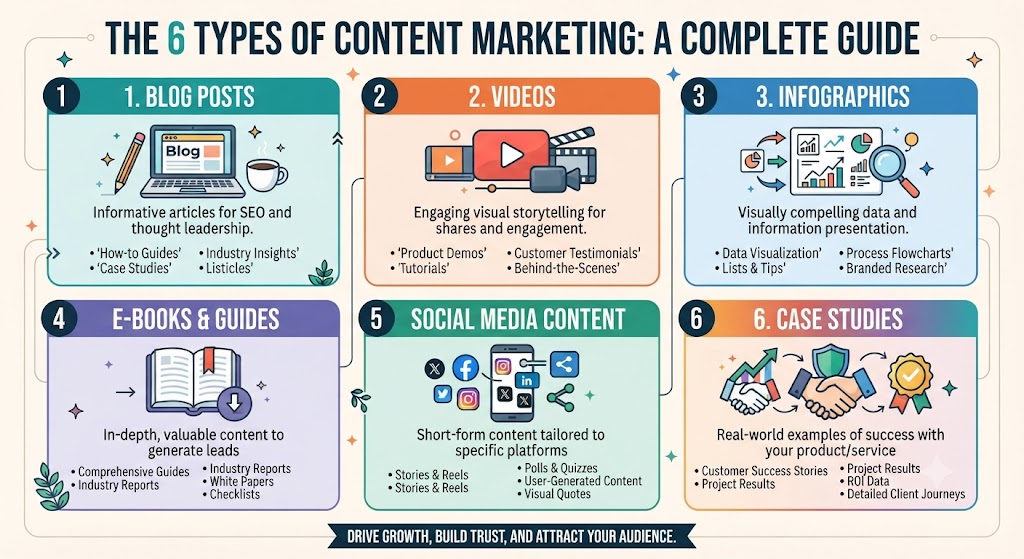
Blog content marketing involves creating informative and engaging articles that educate readers, answer common questions, and provide solutions to their problems. Businesses use blogs to share industry knowledge, improve search engine rankings, and attract organic traffic. Well-written blog posts help establish a brand as an authority in its field while encouraging visitors to spend more time on the website and explore additional products or services.
Video Content Marketing
Video content marketing uses visual storytelling to capture attention and communicate information in an engaging way. Businesses create product demonstrations, tutorials, customer testimonials, interviews, behind-the-scenes videos, webinars, and educational content to connect with their audience. Videos can be shared on platforms such as YouTube, social media, and business websites, making them one of the most effective content formats for increasing engagement and brand awareness.
Social Media Content Marketing
Social media content marketing focuses on creating and sharing content across platforms such as Facebook, Instagram, LinkedIn, X (formerly Twitter), TikTok, Pinterest, and YouTube. This content may include images, reels, stories, carousels, short videos, polls, and live sessions designed to engage followers and encourage interaction. By consistently publishing valuable content, businesses can strengthen customer relationships, increase brand visibility, and drive traffic to their websites.
Infographic Content Marketing
Infographic content marketing presents complex information, statistics, or processes through visually appealing graphics. Infographics combine images, charts, icons, and concise text to make information easy to understand and share. They are widely used for explaining concepts, presenting research findings, and simplifying data, making them highly effective for improving audience engagement and increasing content shares across websites and social media platforms.
eBook and Guide Content Marketing
eBooks and comprehensive guides provide detailed information on specific topics, helping readers gain a deeper understanding of a subject. These long-form resources are often offered as downloadable content in exchange for contact information, making them valuable tools for lead generation. Businesses use eBooks and guides to demonstrate expertise, educate potential customers, and support decision-making throughout the buying journey.
Podcast Content Marketing
Podcast content marketing involves creating audio-based content that audiences can listen to while commuting, exercising, or performing daily activities. Businesses use podcasts to share expert insights, conduct interviews, discuss industry trends, and provide educational content. Podcasts help build a loyal audience by offering convenient and engaging information in an easily accessible format.
Case Study Content Marketing
Case studies showcase real-life examples of how a company's product or service solved a customer's problem or achieved measurable results. They provide evidence of success by highlighting challenges, solutions, and outcomes. Case studies build credibility, demonstrate expertise, and help potential customers gain confidence before making purchasing decisions.
FREQUENTLY ASKED QUESTION ( FAQ )
Content marketing helps businesses attract potential customers, build trust, improve brand awareness, and establish authority in their industry. By consistently providing valuable content, businesses can generate qualified leads, increase customer engagement, and support long-term growth.
The ideal publishing frequency depends on your goals, audience, and available resources. However, maintaining a consistent schedule—such as publishing one or two high-quality pieces of content each week—can help improve audience engagement and search engine visibility.
There is no single best type of content. Blog posts, videos, social media posts, infographics, podcasts, and email newsletters can all be effective when they are tailored to the target audience and aligned with business objectives. The most successful strategy often combines multiple content formats.
Content marketing supports SEO by providing original, keyword-optimized content that answers users' questions and matches their search intent. High-quality content can improve search rankings, attract organic traffic, earn backlinks, and increase the amount of time visitors spend on a website.
The success of content marketing can be measured using key performance indicators (KPIs) such as website traffic, organic search rankings, engagement rates, time on page, social media shares, lead generation, conversion rates, and return on investment (ROI). Regularly analyzing these metrics helps businesses refine their content strategy and improve future performance.