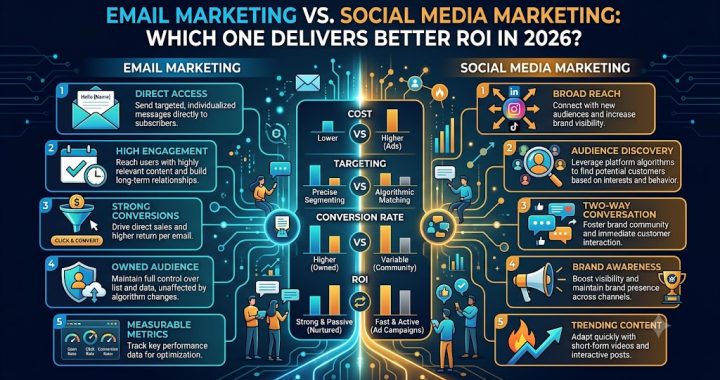
Email Marketing vs Social Media Marketing: Which One Delivers Better ROI in 2026?
Meta Title: Email Marketing vs Social Media Marketing: Which One Delivers Better ROI?
Meta Description: Compare email marketing and social media marketing to discover which delivers better ROI. Learn the key differences, benefits, costs, and how to choose the right strategy for your business in 2026.
Focus Keyword: Email Marketing vs Social Media Marketing
Email Marketing vs Social Media Marketing: Which One Delivers Better ROI in 2026?
Businesses today have more marketing channels available than ever before, but two of the most effective are email marketing and social media marketing. Both help brands connect with customers, increase awareness, generate leads, and drive sales. However, when marketing budgets are limited, one question often arises: Which channel delivers the better return on investment (ROI)?
The answer isn’t as simple as choosing one over the other. Each channel has unique strengths, serves different purposes, and performs differently depending on your business goals, audience, and marketing strategy.
Email marketing gives businesses direct access to subscribers who have already shown interest in their brand, while social media marketing helps reach new audiences and encourages conversations through engaging content.
In this guide, we’ll compare email marketing and social media marketing across key factors such as cost, audience reach, engagement, conversions, and long-term value to help you decide where to focus your efforts.
What Is Email Marketing?
Email marketing is a digital marketing strategy that involves sending targeted emails to subscribers who have voluntarily joined your mailing list.
Businesses use email marketing to:
- Share newsletters
- Promote products and services
- Announce new launches
- Deliver educational content
- Recover abandoned carts
- Build customer loyalty
- Generate repeat sales
Because subscribers have already given permission to receive emails, communication is more personal and targeted.
What Is Social Media Marketing?
Social media marketing involves promoting a business through platforms such as:
- X (formerly Twitter)
- YouTube
- TikTok
Businesses use these platforms to:
- Increase brand awareness
- Build communities
- Share content
- Engage with customers
- Promote products
- Run advertising campaigns
- Drive website traffic
Unlike email marketing, social media also helps businesses reach people who may not yet know about their brand.
Understanding ROI in Digital Marketing
Return on Investment (ROI) measures how much value your marketing efforts generate compared to the money and time invested.
A successful marketing channel should help you:
- Generate qualified leads
- Increase conversions
- Build customer relationships
- Improve customer retention
- Strengthen brand awareness
- Support long-term business growth
Both email and social media can contribute to these goals, but they do so in different ways.
Email Marketing vs Social Media Marketing: Key Differences
| Feature | Email Marketing | Social Media Marketing |
|---|---|---|
| Audience Ownership | You own your subscriber list | Platform owns the audience |
| Reach | Direct inbox delivery | Controlled by platform algorithms |
| Personalization | Highly personalized | Limited personalization |
| Customer Relationship | Strong long-term engagement | Broad public interaction |
| Organic Visibility | High with engaged subscribers | Can decline due to algorithm changes |
| Cost | Low ongoing cost | Organic is free; ads may require larger budgets |
| Conversion Potential | Generally higher | Strong for awareness and engagement |
| Analytics | Detailed campaign metrics | Platform-specific analytics |
Benefits of Email Marketing
Email marketing offers several advantages for businesses seeking long-term customer relationships.
1. Direct Communication
Your message is delivered directly to subscribers without depending on social media algorithms.
2. Higher Personalization
Emails can be customized based on customer behavior, interests, purchases, and preferences.
3. Better Lead Nurturing
Businesses can guide potential customers through the buying journey with automated email sequences.
4. Greater Customer Retention
Regular newsletters and personalized offers help maintain long-term relationships.
5. Strong Conversion Potential
Subscribers are often more likely to make purchases because they have already expressed interest in your business.
Benefits of Social Media Marketing
Social media excels at expanding brand visibility and creating engagement.
1. Massive Audience Reach
Billions of people actively use social media platforms every day.
2. Brand Awareness
Businesses can introduce their products and services to entirely new audiences.
3. Community Building
Social media encourages conversations, comments, and user-generated content that strengthen customer relationships.
4. Visual Storytelling
Photos, videos, live streams, and short-form content help businesses showcase their personality and expertise.
5. Fast Content Distribution
Content can spread quickly through shares, comments, and recommendations.
Cost Comparison
Both strategies can be affordable, but their costs differ.
Email Marketing Costs
Typical expenses include:
- Email marketing software
- List management
- Content creation
- Automation tools
- Design
Once your list is established, ongoing costs are often relatively low.
Social Media Marketing Costs
Expenses may include:
- Content creation
- Graphic design
- Video production
- Community management
- Paid advertising
- Influencer partnerships
Organic social media is free to use, but many businesses invest in advertising to expand their reach.
Which Channel Generates Better Engagement?
Engagement depends on your objectives.
Email marketing typically encourages deeper engagement because subscribers have already shown interest in your business.
Social media encourages:
- Likes
- Comments
- Shares
- Conversations
- Community interaction
Both forms of engagement are valuable, but they support different stages of the customer journey.
Which Delivers Better Conversions?
Email marketing often performs better when the goal is generating sales, encouraging repeat purchases, or nurturing existing leads.
Social media is particularly effective for:
- Brand discovery
- Product awareness
- Community engagement
- Driving visitors to your website
Many businesses use social media to attract visitors and email marketing to convert them into customers.
When Should You Prioritize Email Marketing?
Email marketing is ideal if your goals include:
- Building customer loyalty
- Increasing repeat purchases
- Promoting products
- Sharing educational content
- Nurturing leads
- Recovering abandoned shopping carts
- Driving consistent website traffic
Businesses with established audiences often benefit significantly from email campaigns.
When Should You Focus on Social Media?
Social media marketing works well for businesses that want to:
- Build brand awareness
- Reach new audiences
- Increase community engagement
- Share visual content
- Launch products
- Promote events
- Strengthen brand identity
It is especially valuable during the awareness stage of the customer journey.
Why Combining Both Strategies Works Best
Rather than choosing one channel exclusively, successful businesses often integrate email marketing with social media marketing.
For example:
- Publish valuable content on social media.
- Encourage followers to join your email list.
- Deliver exclusive resources through email.
- Continue nurturing subscribers with personalized campaigns.
- Use email to drive traffic back to new social media content.
This approach combines the broad reach of social media with the long-term relationship-building power of email marketing.
Common Mistakes to Avoid
Avoid these common marketing mistakes:
- Relying entirely on one platform
- Buying email lists
- Ignoring audience segmentation
- Posting inconsistently on social media
- Sending excessive promotional emails
- Neglecting analytics
- Ignoring customer feedback
Successful marketing requires continuous learning and optimization.
Future of Email and Social Media Marketing
Both marketing channels continue evolving with advances in artificial intelligence, automation, personalization, and data analytics.
Future trends include:
- AI-powered content creation
- Hyper-personalized campaigns
- Interactive emails
- Short-form video content
- Social commerce
- Predictive marketing
- Smarter automation
- Privacy-focused customer communication
Businesses that combine these innovations with valuable, customer-focused content will remain competitive.
Final Verdict
Email marketing and social media marketing are not competitors—they are complementary tools that serve different purposes within a successful digital marketing strategy.
Email marketing generally delivers stronger ROI for customer retention, lead nurturing, and conversions because it provides direct access to an audience that has already expressed interest in your business. Its personalization capabilities, automation features, and measurable performance make it an essential channel for long-term growth.
Social media marketing excels at increasing brand awareness, expanding your reach, encouraging engagement, and introducing your business to potential customers. It helps create conversations and build communities that strengthen your online presence.
The highest-performing businesses don’t choose one over the other. Instead, they use social media to attract and engage audiences while using email marketing to nurture relationships and drive conversions. By combining both channels strategically, you can maximize your marketing investment and achieve sustainable business growth.
Frequently Asked Questions
Which has a better ROI: email marketing or social media marketing?
Email marketing often delivers a higher ROI for conversions and customer retention, while social media is more effective for brand awareness and audience growth.
Is email marketing still relevant in 2026?
Yes. Email marketing remains one of the most effective ways to communicate directly with customers and build long-term relationships.
Can small businesses use both strategies?
Absolutely. Small businesses can use social media to reach new audiences and email marketing to maintain relationships with subscribers and customers.
Which channel is better for generating leads?
Both can generate leads. Social media helps attract potential customers, while email marketing nurtures those leads into paying customers.
Should I invest in email marketing or social media first?
If you’re building brand awareness, start with social media. As your audience grows, focus on building an email list to strengthen customer relationships and improve long-term marketing performance.