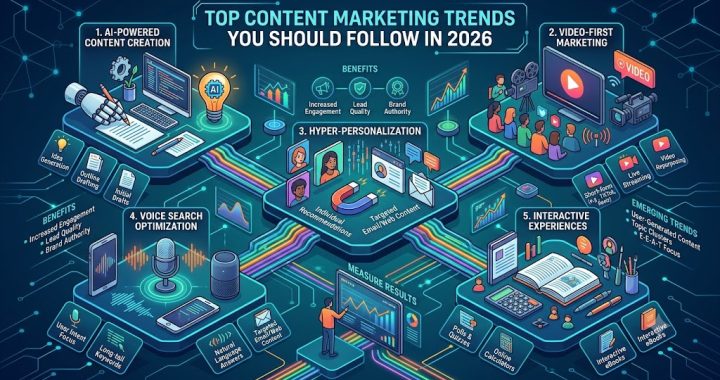
Top Content Marketing Trends You Should Follow in 2026
Meta Title: Top Content Marketing Trends You Should Follow in 2026
Meta Description: Explore the top content marketing trends in 2026, including AI-powered content, video marketing, personalization, voice search, and SEO strategies to grow your business.
Focus Keyword: Content Marketing Trends 2026
Top Content Marketing Trends You Should Follow in 2026
Content marketing continues to evolve as technology, search engines, and consumer behavior change. Businesses that adapt to new trends are more likely to attract customers, improve search visibility, and build stronger relationships with their audience. In 2026, creating valuable content is still the foundation of a successful marketing strategy, but how that content is planned, created, and distributed is changing rapidly.
Artificial intelligence, interactive experiences, personalized content, and video-first strategies are shaping the future of digital marketing. At the same time, search engines continue rewarding websites that publish trustworthy, experience-based, and user-focused content. Businesses that combine innovation with quality will have the best opportunity to stand out in an increasingly competitive online environment.
This guide explores the most important content marketing trends you should follow in 2026 and explains how each trend can help your business grow.
Why Content Marketing Trends Matter
Marketing trends reflect changing customer expectations and technological developments. Businesses that ignore these changes may find it harder to reach their audience, while those that adapt can improve engagement, increase website traffic, and strengthen their brand authority.
Keeping up with trends allows you to:
- Reach new audiences
- Improve customer engagement
- Increase organic search traffic
- Build stronger brand credibility
- Stay competitive
- Improve conversion rates
- Maximize your marketing investment
Rather than chasing every new idea, focus on trends that align with your business goals and your audience’s needs.
1. AI-Assisted Content Creation
Artificial intelligence has become one of the most influential tools in content marketing. AI can help marketers brainstorm ideas, organize outlines, improve readability, optimize headlines, and analyze content performance.
AI is especially useful for repetitive tasks such as:
- Topic research
- Keyword clustering
- Content briefs
- Grammar checking
- Image generation
- Social media captions
- Email subject lines
However, AI should support human creativity—not replace it. Businesses that combine AI efficiency with original insights and expert knowledge are more likely to produce content that resonates with readers.
2. Video-First Content Marketing
Video remains one of the most engaging content formats. Short-form videos, tutorials, webinars, product demonstrations, and educational content continue to attract audiences across multiple platforms.
Businesses are increasingly using videos to:
- Explain products
- Share customer success stories
- Demonstrate services
- Educate potential customers
- Increase social media engagement
Repurposing blog articles into videos is an effective way to expand your reach while maximizing the value of existing content.
3. Personalization at Scale
Today’s audiences expect content that feels relevant to their interests and needs.
Personalization includes:
- Customized email campaigns
- Product recommendations
- Location-specific content
- Dynamic website experiences
- Personalized landing pages
By understanding customer behavior and preferences, businesses can deliver more meaningful experiences that improve engagement and conversions.
4. Voice Search Optimization
As voice-enabled devices become more common, people increasingly search using natural, conversational language.
To optimize for voice search:
- Answer common questions clearly.
- Use long-tail keywords.
- Write in a conversational tone.
- Include FAQ sections.
- Focus on local search when relevant.
Content that directly answers user questions has a better chance of appearing in voice search results.
5. Building Topical Authority
Instead of publishing isolated articles, successful businesses are creating comprehensive content around a specific subject.
This approach involves:
- Publishing pillar pages
- Creating related supporting articles
- Linking relevant content together
- Covering topics in depth
Building topical authority helps search engines understand your expertise and can improve rankings across an entire topic area.
6. Interactive Content
Interactive content encourages users to participate rather than simply consume information.
Examples include:
- Quizzes
- Polls
- Surveys
- Calculators
- Interactive infographics
- Assessments
- Product recommendation tools
Interactive experiences often increase engagement and encourage visitors to spend more time on your website.
7. User-Generated Content
Customers trust recommendations from other customers.
User-generated content includes:
- Reviews
- Testimonials
- Photos
- Videos
- Social media mentions
- Case studies
Encouraging customers to share their experiences builds authenticity and strengthens your brand’s reputation.
8. E-E-A-T and Trust-Based Content
Search engines continue placing greater emphasis on content that demonstrates:
- Experience
- Expertise
- Authoritativeness
- Trustworthiness
Businesses can strengthen trust by:
- Publishing accurate information
- Citing reliable sources when appropriate
- Updating content regularly
- Demonstrating real-world experience
- Being transparent about products and services
Trust remains one of the most valuable assets in digital marketing.
9. Content Repurposing
Creating quality content requires time and resources.
Instead of producing entirely new material for every platform, marketers are repurposing existing content into multiple formats.
For example:
A single blog article can become:
- A YouTube video
- An Instagram carousel
- Several social media posts
- An email newsletter
- A podcast discussion
- An infographic
Repurposing improves efficiency while reaching audiences across different channels.
10. Data-Driven Content Decisions
Successful marketers rely on analytics rather than assumptions.
Important metrics include:
- Organic traffic
- Keyword rankings
- Conversion rate
- Bounce rate
- Time on page
- Social engagement
- Email performance
- Lead generation
Analyzing performance helps businesses identify which content delivers the greatest value and where improvements are needed.
How Businesses Can Prepare for These Trends
Adapting to new trends doesn’t require changing everything overnight.
Start by:
- Creating high-quality, audience-focused content.
- Investing in SEO.
- Experimenting with video.
- Using AI responsibly.
- Building topic clusters.
- Updating existing content.
- Measuring performance consistently.
- Listening to customer feedback.
Small improvements made consistently often produce stronger long-term results than dramatic changes.
Common Mistakes to Avoid
While following trends is important, avoid these common mistakes:
- Prioritizing trends over audience needs
- Publishing AI-generated content without editing
- Ignoring SEO fundamentals
- Chasing every new platform
- Producing content without a clear strategy
- Neglecting content updates
Successful content marketing balances innovation with consistency and quality.
The Future of Content Marketing
Looking beyond 2026, content marketing is expected to become even more personalized, interactive, and data-driven. Businesses will continue integrating artificial intelligence into their workflows while focusing on authentic storytelling and meaningful customer relationships.
Search engines are also expected to place greater importance on user experience, content quality, and demonstrated expertise. Organizations that invest in helpful, trustworthy content rather than short-term promotional tactics will be better positioned for long-term success.
Regardless of future technological changes, one principle will remain constant: creating valuable content that genuinely helps people will always be at the heart of effective content marketing.
Conclusion
Content marketing in 2026 is about more than simply publishing blog posts. Businesses must understand changing customer expectations, embrace new technologies responsibly, and create content that delivers genuine value.
From AI-assisted content creation and video marketing to personalization, topical authority, voice search optimization, and trust-based publishing, today’s trends provide exciting opportunities for businesses willing to adapt.
Rather than trying to implement every trend immediately, focus on the ones that best support your audience and business objectives. Consistency, quality, and continuous improvement remain the foundations of successful content marketing.
By staying informed and adapting thoughtfully, your business can strengthen its online presence, attract more qualified visitors, and build lasting relationships with customers.
Frequently Asked Questions
What is the biggest content marketing trend in 2026?
AI-assisted content creation combined with human expertise is one of the most significant trends, helping businesses improve productivity while maintaining high-quality content.
Is SEO still important for content marketing?
Yes. Search engine optimization remains essential for helping valuable content reach users through organic search results.
Why is video becoming more important?
Video content is highly engaging and works well across websites, social media platforms, and email campaigns, making it an effective way to reach diverse audiences.
How often should businesses update their content?
Reviewing and updating important articles every few months—or whenever information changes—helps maintain accuracy, improve user experience, and support search visibility.
Should businesses follow every content marketing trend?
No. Focus on trends that align with your audience, resources, and business goals. Implementing a few strategies effectively is usually more beneficial than trying to adopt every new trend at once.