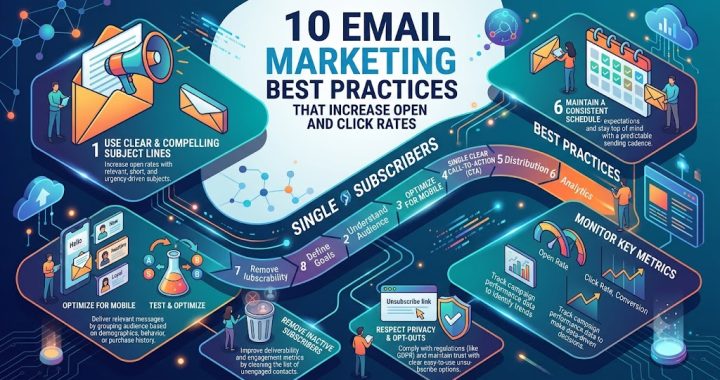
10 Email Marketing Best Practices That Increase Open and Click Rates
Meta Title: 10 Email Marketing Best Practices That Increase Open and Click Rates
Meta Description: Discover 10 proven email marketing best practices to improve open rates, boost click-through rates, increase engagement, and maximize your email campaign performance in 2026.
Focus Keyword: Email Marketing Best Practices
10 Email Marketing Best Practices That Increase Open and Click Rates
Email marketing remains one of the highest-performing digital marketing channels because it allows businesses to communicate directly with customers and prospects. However, sending emails alone is not enough. Every day, inboxes are filled with newsletters, promotions, and updates competing for attention. If your emails are ignored or deleted, even the best offer will fail to produce results.
Successful email marketing depends on creating campaigns that encourage people to open your emails, read your content, and take action. This requires thoughtful planning, personalization, strong copywriting, and continuous optimization.
Whether you are promoting products, sharing educational content, or nurturing leads, following proven best practices can significantly improve your campaign performance. In this guide, you’ll learn ten effective email marketing practices that help increase both open rates and click-through rates while building stronger relationships with your audience.
Why Open and Click Rates Matter
Open rate measures the percentage of recipients who open your email, while click-through rate (CTR) measures how many people click a link within your email.
These metrics help you understand whether your campaigns are attracting attention and encouraging engagement.
Higher open and click rates can lead to:
- Increased website traffic
- More qualified leads
- Better customer engagement
- Higher sales opportunities
- Improved return on investment (ROI)
- Stronger customer relationships
Improving these metrics requires more than attractive designs—it requires delivering relevant content at the right time to the right audience.
1. Write Compelling Subject Lines
Your subject line is often the deciding factor in whether someone opens your email.
An effective subject line should be:
- Clear
- Relevant
- Concise
- Honest
- Attention-grabbing
Examples include:
- “5 Simple Ways to Improve Your Website SEO”
- “Your Free Marketing Checklist Is Ready”
- “Exclusive Tips to Grow Your Online Business”
Avoid misleading subject lines or excessive use of capital letters and symbols, as these can reduce trust and affect deliverability.
2. Personalize Every Email
Personalization goes beyond simply including the recipient’s name.
Use subscriber data to deliver content based on:
- Interests
- Purchase history
- Website activity
- Location
- Previous interactions
Relevant emails create a better experience and encourage higher engagement.
For example, an online store can recommend products similar to a customer’s previous purchases instead of sending the same promotion to everyone.
3. Segment Your Email List
Not every subscriber has the same needs.
Segment your audience into smaller groups based on factors such as:
- New subscribers
- Existing customers
- Frequent buyers
- Industry
- Geographic location
- Engagement level
Segmented campaigns typically perform better because recipients receive information that matches their interests.
4. Focus on Valuable Content
Subscribers remain engaged when your emails consistently provide value.
Useful content may include:
- Educational articles
- Industry updates
- Product tutorials
- Helpful tips
- Exclusive resources
- Customer success stories
- Special offers
Aim to educate, inform, or solve problems rather than sending constant sales messages.
A healthy balance between promotional and educational content builds long-term trust.
5. Optimize for Mobile Devices
Many people read emails on smartphones or tablets.
Ensure your emails are:
- Mobile responsive
- Easy to read
- Fast loading
- Simple to navigate
Use:
- Short paragraphs
- Readable fonts
- Responsive images
- Large call-to-action buttons
A poor mobile experience can reduce engagement and increase unsubscribe rates.
6. Include a Clear Call-to-Action (CTA)
Every email should encourage readers to take one primary action.
Examples include:
- Read a blog post
- Download a guide
- Register for a webinar
- Shop a product
- Contact your business
- Schedule a consultation
Use clear action-oriented language such as:
- Learn More
- Download Now
- Get Started
- Explore the Guide
- View the Offer
Avoid overwhelming subscribers with multiple competing calls-to-action.
7. Send Emails at the Right Time
Timing can influence campaign performance.
Although the ideal sending time varies by audience, testing different schedules helps identify when subscribers are most likely to engage.
Consider factors such as:
- Time zones
- Work schedules
- Industry
- Customer behavior
Regular testing allows you to optimize future campaigns based on real engagement data.
8. Test and Improve Your Campaigns
A/B testing helps determine which email variations perform better.
Test elements such as:
- Subject lines
- Preview text
- Images
- Headlines
- Call-to-action buttons
- Email layout
- Sending time
Changing one variable at a time provides clearer insights into what influences subscriber behavior.
Continuous testing leads to steady improvements over time.
9. Keep Your Email List Healthy
Maintaining a clean email list improves deliverability and engagement.
Regularly:
- Remove invalid addresses
- Delete inactive subscribers
- Monitor bounce rates
- Update subscriber preferences
- Honor unsubscribe requests promptly
A smaller, engaged audience is more valuable than a large list of inactive contacts.
10. Analyze Campaign Performance
Successful email marketing relies on ongoing measurement.
Track important metrics including:
- Open rate
- Click-through rate
- Conversion rate
- Bounce rate
- Unsubscribe rate
- Email sharing
- Revenue generated
- List growth rate
Reviewing these metrics helps identify successful campaigns and opportunities for improvement.
Additional Tips for Better Email Performance
Beyond the core best practices, consider these recommendations:
- Use a recognizable sender name.
- Keep your branding consistent.
- Write conversational copy.
- Avoid excessive promotional language.
- Include alt text for images.
- Maintain a logical email structure.
- Proofread before sending.
- Deliver on the expectations set during signup.
Small improvements across multiple areas often lead to significant performance gains.
Common Email Marketing Mistakes
Many businesses unintentionally reduce campaign effectiveness by making avoidable mistakes.
Common mistakes include:
- Sending emails too frequently
- Ignoring audience segmentation
- Using misleading subject lines
- Overloading emails with images
- Forgetting mobile optimization
- Including too many links
- Neglecting analytics
- Purchasing email lists
Avoiding these errors improves user experience and helps build long-term subscriber trust.
Future of Email Marketing
Email marketing continues to evolve with advances in technology and customer expectations.
Emerging trends include:
- AI-assisted personalization
- Predictive automation
- Interactive email content
- Privacy-focused marketing
- Smarter segmentation
- Behavior-based campaigns
- Dynamic email content
Businesses that adapt to these trends while maintaining high-quality communication will remain competitive in the years ahead.
Conclusion
Improving email open rates and click-through rates requires more than attractive designs or promotional offers. Successful email marketing focuses on understanding your audience, delivering valuable content, personalizing communication, and continuously optimizing campaigns based on performance data.
The ten best practices outlined in this guide provide a strong foundation for creating more engaging email campaigns. By writing compelling subject lines, segmenting your audience, optimizing for mobile devices, testing different approaches, and maintaining a healthy email list, you can build stronger relationships with subscribers while increasing traffic, leads, and conversions.
Remember that email marketing is an ongoing process. Small improvements made consistently over time often produce the greatest long-term results.
Frequently Asked Questions
What is a good email open rate?
A good open rate varies by industry, but consistently improving your own campaign performance is more important than focusing on a universal benchmark.
Why are my email open rates low?
Common reasons include weak subject lines, poor audience targeting, inconsistent sending schedules, outdated email lists, or content that doesn’t match subscriber expectations.
How can I increase my email click-through rate?
Provide valuable content, use clear calls-to-action, personalize your emails, optimize for mobile devices, and segment your audience for better relevance.
Should I send promotional emails every week?
Not necessarily. Balance promotional content with educational and informative emails to keep subscribers engaged without overwhelming them.
Why is segmentation important in email marketing?
Segmentation allows you to send more relevant content to different groups of subscribers, leading to higher engagement, improved click rates, and better conversion opportunities.