How to Create a High-Converting Google Ads Campaign Step by Step (2026 Guide)
Meta Title: How to Create a High-Converting Google Ads Campaign | Step-by-Step Guide
Meta Description: Learn how to create a high-converting Google Ads campaign with this complete step-by-step guide. Discover keyword research, bidding strategies, ad copywriting, targeting, optimization, and conversion tracking.
Focus Keyword: Google Ads Campaign
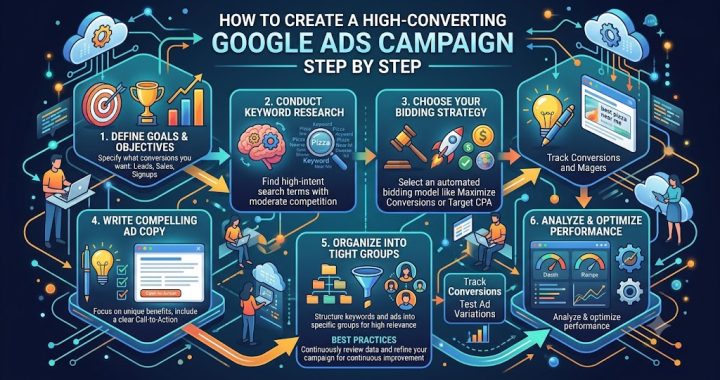
How to Create a High-Converting Google Ads Campaign Step by Step
Google Ads has become one of the most effective digital advertising platforms for businesses that want to attract qualified leads, increase website traffic, and boost sales. Unlike traditional advertising, Google Ads allows you to reach people who are already searching for products or services similar to yours. This means your ads appear when potential customers have a strong intent to take action.
However, simply launching a campaign is not enough. Many businesses waste advertising budgets because they target the wrong audience, choose poor keywords, or fail to optimize their campaigns. A successful Google Ads campaign requires careful planning, compelling ad copy, strategic bidding, and continuous performance monitoring.
Whether you own a small business, an eCommerce store, or a digital marketing agency, this step-by-step guide will help you build a Google Ads campaign that delivers better conversions and a stronger return on investment (ROI).
What Makes a Google Ads Campaign Successful?
A high-converting campaign doesn’t necessarily have the biggest budget. Instead, it focuses on showing the right ad to the right audience at the right time.
Successful campaigns usually have:
- Clearly defined goals
- Well-researched keywords
- Relevant audience targeting
- High-quality ad copy
- Optimized landing pages
- Smart bidding strategies
- Conversion tracking
- Ongoing optimization
Each of these elements works together to improve campaign performance and reduce wasted spending.
Step 1: Define Your Campaign Goal
Before creating your campaign, decide what you want to achieve.
Common Google Ads objectives include:
- Generate website traffic
- Increase online sales
- Collect leads
- Receive phone calls
- Promote local business visits
- Increase brand awareness
- Encourage app downloads
Your campaign settings, bidding strategy, and ad format should align with your primary business objective.
Step 2: Understand Your Target Audience
Knowing your audience helps you create more relevant ads.
Consider factors such as:
- Age
- Location
- Language
- Interests
- Buying behavior
- Devices used
- Search intent
For example, a local service business should target users within its service area rather than advertising nationwide.
Audience research improves ad relevance and increases conversion opportunities.
Step 3: Conduct Keyword Research
Keywords determine when your ads appear.
Choose keywords that closely match what your potential customers are searching for.
Focus on:
- High-intent keywords
- Long-tail keywords
- Local keywords
- Commercial intent searches
Examples:
- Best digital marketing agency
- Google Ads management services
- SEO company near me
- Buy running shoes online
Avoid selecting broad keywords that attract irrelevant traffic.
Step 4: Organize Your Ad Groups
Create tightly themed ad groups instead of placing every keyword into one campaign.
Example:
Campaign:
Digital Marketing Services
Ad Groups:
- SEO Services
- Google Ads Services
- Social Media Marketing
- Email Marketing
Each ad group should contain closely related keywords and advertisements.
This improves Quality Score and makes your ads more relevant.
Step 5: Write Compelling Ad Copy
Your advertisement should quickly explain why someone should choose your business.
Include:
- Primary keyword
- Unique selling point
- Customer benefit
- Strong call-to-action
Examples of CTAs:
- Get Your Free Quote
- Contact Our Experts
- Book a Free Consultation
- Start Today
- Learn More
Good ad copy focuses on solving customer problems rather than simply describing your business.
Step 6: Create a High-Converting Landing Page
Your landing page should match the promise made in your advertisement.
An effective landing page includes:
- Clear headline
- Relevant information
- Fast loading speed
- Mobile-friendly design
- Trust signals
- Customer testimonials
- Easy navigation
- Simple contact form
- Strong call-to-action
Sending visitors to a generic homepage often reduces conversion rates.
Dedicated landing pages usually perform much better.
Step 7: Choose the Right Bidding Strategy
Google Ads offers several bidding options depending on your campaign goals.
Popular strategies include:
Manual CPC
Provides greater control over individual keyword bids.
Maximize Clicks
Designed to generate as many clicks as possible within your budget.
Maximize Conversions
Uses automation to increase conversions while staying within your budget.
Target CPA
Focuses on achieving conversions at your desired average cost per acquisition.
Target ROAS
Suitable for businesses focused on maximizing return on advertising spend.
Choose the strategy that best supports your marketing objectives.
Step 8: Set a Realistic Budget
Your advertising budget should reflect your business goals and competition.
Consider:
- Daily budget
- Monthly budget
- Cost-per-click estimates
- Expected conversions
- Industry competition
Starting with a moderate budget allows you to gather performance data before increasing your investment.
Step 9: Enable Conversion Tracking
Without conversion tracking, it’s impossible to know whether your campaign is producing results.
Track actions such as:
- Form submissions
- Phone calls
- Online purchases
- Newsletter sign-ups
- Appointment bookings
- Downloads
Accurate tracking helps identify which keywords, ads, and landing pages generate the highest return.
Step 10: Optimize Your Campaign Regularly
Google Ads requires continuous improvement.
Review your campaign regularly by analyzing:
- Click-through rate (CTR)
- Conversion rate
- Cost per click (CPC)
- Cost per acquisition (CPA)
- Search terms
- Quality Score
- Impression share
Optimization may include:
- Adding negative keywords
- Improving ad copy
- Adjusting bids
- Testing new landing pages
- Refining audience targeting
Small improvements over time often produce significant long-term gains.
Tips to Increase Conversion Rates
To maximize campaign performance:
- Focus on search intent.
- Use highly relevant keywords.
- Write clear headlines.
- Include compelling offers.
- Improve landing page speed.
- Add customer testimonials.
- Use ad extensions.
- Test multiple ad variations.
- Optimize for mobile devices.
- Review campaign data consistently.
A data-driven approach helps improve both performance and profitability.
Common Google Ads Mistakes to Avoid
Many beginners waste advertising budgets by making avoidable mistakes.
Common errors include:
- Targeting overly broad keywords
- Ignoring negative keywords
- Sending traffic to the homepage
- Writing generic advertisements
- Not testing different ad versions
- Ignoring Quality Score
- Failing to track conversions
- Stopping campaigns too quickly
Avoiding these mistakes can improve campaign efficiency and reduce unnecessary spending.
Measuring Campaign Success
Monitor important performance metrics, including:
- Click-through rate (CTR)
- Conversion rate
- Cost per click (CPC)
- Cost per conversion
- Return on ad spend (ROAS)
- Quality Score
- Impression share
- Total conversions
Regular reporting helps identify opportunities for improvement and supports better decision-making.
Future of Google Ads
Google Ads continues to evolve with advancements in artificial intelligence and automation.
Important trends include:
- AI-powered campaign optimization
- Smart bidding
- Performance Max campaigns
- Better audience signals
- Predictive analytics
- First-party data strategies
- Automated asset creation
Businesses that combine automation with strategic planning and creative messaging are likely to achieve stronger results.
Conclusion
Creating a high-converting Google Ads campaign requires more than choosing a few keywords and setting a budget. Success comes from understanding your audience, selecting relevant keywords, writing persuasive advertisements, optimizing landing pages, tracking conversions, and continuously improving campaign performance.
Whether you’re launching your first campaign or refining an existing one, following a structured process helps maximize your advertising investment and reduce wasted spend. Remember that Google Ads is not a one-time setup but an ongoing optimization process that rewards careful analysis and regular adjustments.
With the right strategy, Google Ads can become one of the most powerful tools for generating qualified leads, increasing sales, and growing your business in 2026 and beyond.
Frequently Asked Questions
What is the first step in creating a Google Ads campaign?
The first step is defining a clear business objective, such as generating leads, increasing sales, driving website traffic, or building brand awareness.
How much budget should I start with?
The ideal budget depends on your industry, competition, and goals. Starting with a manageable daily budget allows you to gather performance data before scaling your campaigns.
Why is keyword research important?
Keyword research ensures your ads appear for searches that are relevant to your products or services, improving both traffic quality and conversion potential.
What is Quality Score in Google Ads?
Quality Score is Google’s measure of the relevance and quality of your keywords, ads, and landing pages. A higher score can improve ad placement and reduce advertising costs.
How often should I optimize my campaign?
Review your campaign performance regularly—ideally every week or month depending on your budget and campaign size. Continuous optimization helps improve ROI and maintain strong performance over time.